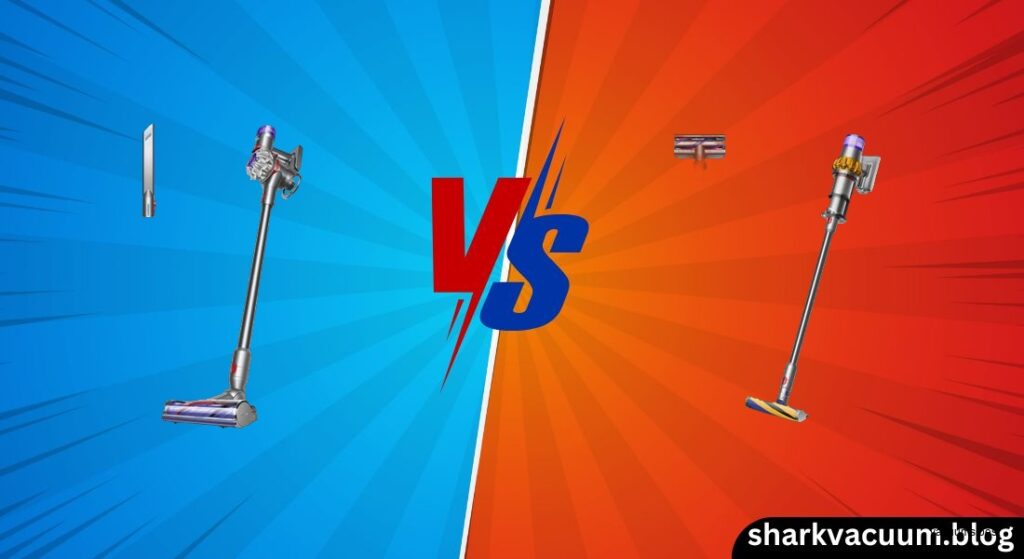
The cordless vacuum market is dominated by Dyson, but choosing between their models can be confusing. On one side, we have the Dyson V8, a legendary workhorse known for its reliability, lightweight design, and proven track record as the go-to choice for pet owners on a budget. On the other, the Dyson V15 Detect represents the pinnacle of current cleaning technology, boasting laser illumination, particle-counting sensors, and significantly higher suction power.
This article provides a data-driven comparison to help you decide: Is the V8’s value and simplicity enough, or does the V15’s “scientific” approach and raw power justify the premium price tag? We break down performance, battery life, filtration, and real-world usability to determine which machine deserves a spot in your home.
2. Product Overviews
Dyson V8: The Reliable Classic
The Dyson V8 is engineered for versatility and ease of use. Powered by the Dyson Digital Motor V8 (110,000 rpm), it delivers up to 115 Air Watts of suction. It features a fully sealed 5-stage filtration system that captures 99.99% of particles as small as 0.3 microns. This makes it especially effective for capturing pet dander, dust mites, and other allergens—critical for households with pets or sensitivities.
One of the V8’s standout features is its Motorbar™ cleaner head, which uses 43 anti-tangle de-tangling vanes made of polycarbonate to automatically clear long hair and pet fur from the brush bar. This means less manual cleaning and fewer interruptions during use. The Fluffy™ cleaner head, included in the Absolute model, is optimized for hard floors with soft woven nylon and anti-static carbon fiber filaments that lift fine dust without scratching surfaces.
Weighing just 5.82 lbs, the V8 is one of the lighter Dyson cordless models, with the motor and battery positioned around the handle for balanced floor-to-ceiling cleaning. Its point-and-shoot bin emptying mechanism allows for hygienic disposal without touching debris, and the 0.14-gallon bin is adequate for daily maintenance, though it may need frequent emptying in messier homes.
Charging takes up to 5 hours, and while runtime in standard mode reaches 40 minutes, it drops sharply to about 10 minutes in Max mode. Despite this, the V8 remains a favorite for its consistent, fade-free suction, thanks to Dyson’s Root Cyclone™ technology with 15 cyclones that prevent clogging and maintain power.
Pro Tip: The V8 Absolute model includes both the Motorbar™ and Fluffy™ heads, making it ideal for homes with mixed flooring. The standard V8 only includes the Motorbar™ head, limiting hard floor performance.
Check the latest price of Dyson V8 Absolute on Amazon [link]
Dyson V15 Detect: The Intelligent Powerhouse
The Dyson V15 Detect is a premium cleaning system powered by the Hyperdymium motor (125,000 rpm), generating up to 230 Air Watts of suction—double that of the V8. This leap in power translates to deeper carpet cleaning and more effective pickup of embedded debris, especially in high-traffic areas or homes with pets.
Its defining feature is the “Detect” system: a piezo sensor that counts and categorizes dust particles by size (0–500+ microns) and displays them in real time on an LCD screen. This isn’t just a gimmick—it provides scientific proof that your floors are actually clean, not just look clean. For allergy sufferers or perfectionists, this feedback can be transformative.
Even more impactful is the Laser Slim Fluffy™ head, which projects a precisely angled green laser across hard floors, illuminating dust particles invisible to the naked eye. This feature alone changes how you clean, revealing lint, pet hair, and fine debris that standard vacuums miss. The laser can be turned off to save battery, but most users find it too compelling to ignore.
The Dynamic Load Sensor (DLS) monitors resistance 360 times per second and automatically adjusts suction based on floor type and debris load. In Auto mode, the vacuum ramps up when it hits a carpet or a pile of dirt, then scales back on hard floors—saving battery while optimizing performance.
With a 0.2-gallon bin—43% larger than the V8’s—and a 6.8-lb weight, the V15 feels more substantial. It lacks a trigger lock, requiring you to hold the power button continuously, which can cause fatigue during long cleaning sessions. Still, its advanced filtration system maintains 99.97% efficiency at 0.3 microns, and long-term fog tests show no leakage from seals or joints after five years of use.
See current deals on Dyson V15 Detect here [link]
3. Comparison Criteria
To provide a fair assessment, we evaluated both vacuums across six critical categories:
- Suction & Cleaning Performance: Raw power and effectiveness on carpets vs. hard floors.
- Intelligence & Features: Sensor tech, LCD displays, and automation.
- Battery Life & Runtime: Endurance in different modes and charging time.
- Design & Ergonomics: Weight, balance, bin capacity, and ease of emptying.
- Filtration & Allergens: Sealed system efficiency and maintenance.
- Value & Durability: Price-to-performance ratio and long-term reliability data.
Each category was assessed using manufacturer specs, real-world user feedback, and long-term durability testing data to ensure an honest, practical comparison.
4. Head-to-Head Comparison
Suction & Cleaning Performance
When it comes to raw cleaning power, the Dyson V15 Detect clearly outperforms the V8. With 230 Air Watts, the V15 generates twice the suction of the V8’s 115 Air Watts. In independent sand pickup tests, the V15 maintains 99.8% efficiency on hard floors and 100% extraction from mid-pile carpets—even after five years of daily use. This level of sustained performance is exceptional.
The Digital Motorbar™ head on the V15 uses 7,815 stiff nylon bristles to dig deep into carpet fibers, lifting ground-in dirt that the V8 might leave behind. While the V8’s Motorbar™ head is effective for daily maintenance, it struggles with heavily soiled carpets or thick pet hair accumulation.
On hard floors, the V8’s Fluffy™ head performs well, but the V15’s Laser Slim Fluffy™ head is a game-changer. The laser reveals microscopic dust that standard vacuums—and eyes—miss. This isn’t just about cleaning; it’s about verifying cleanliness. For users who care about hygiene, this feature is unmatched in the industry.
Both models feature anti-tangle technology, but the V15’s system is more advanced. The Hair Screw Tool on the V15 uses a motor-driven conical brush bar to pick up long hair without tangling, whereas the V8’s version, while effective, requires more frequent manual checks.
🏆 Section Winner: Dyson V15 Detect – The double suction power and laser dust detection make it the superior cleaner, especially for homes with carpets, pets, or allergy concerns.
Intelligence & Features
This is where the Dyson V15 pulls far ahead. The V8 is a “dumb” vacuum in the best sense—it has two manual modes (Standard and Max) and no automation. You control the power, and the machine executes. For users who want simplicity, this is a plus. But it lacks any feedback or adaptation.
The V15, in contrast, is a smart device. Its LCD screen displays real-time particle counts, remaining runtime, and maintenance alerts. The piezo sensor counts dust particles and shows their size distribution—something no other vacuum offers. You can see exactly how much fine dust (0–10 microns) versus larger debris (50+ microns) you’ve picked up.
More practically, the Dynamic Load Sensor (DLS) automatically adjusts suction up to 360 times per second. When transitioning from hardwood to carpet, the motor ramps up seamlessly. In Eco mode, it conserves battery on bare floors; in Auto mode, it optimizes for mixed surfaces. This automation makes whole-home cleaning more efficient and less tiring.
The laser head is the most visually impactful feature. It’s not just a marketing gimmick—it changes user behavior. Seeing dust reappear minutes after cleaning encourages more thorough passes and better maintenance habits.
The V8 offers none of this. It’s a capable cleaner, but it doesn’t adapt or inform. If you value data, automation, and visual feedback, the V15 is in a different league.
🏆 Section Winner: Dyson V15 Detect – The laser, particle counter, and auto-adjust suction offer a level of intelligence the V8 can’t match.
Battery Life & Runtime
Runtime depends heavily on the mode and floor type. The Dyson V8 offers up to 40 minutes in Standard mode, which is sufficient for small to medium homes (under 1,500 sq ft). However, in Max mode, runtime drops to about 10 minutes, limiting its use for deep cleaning.
The Dyson V15, meanwhile, offers up to 60–70 minutes in Eco mode (tested by Consumer Reports), making it ideal for larger homes. In Auto mode, it lasts 40–60 minutes, depending on debris load. Even in Boost mode, it manages 8–9 minutes—slightly less than the V8, but with twice the suction, so it cleans faster.
Charging times are similar: 5 hours for the V8, 4.5 hours for the V15. Both use lithium-ion batteries designed to be left on the charger.
Long-term battery testing reveals a key advantage for the V15: after five years of daily use, its battery lost only 4 minutes of runtime in low mode. Most cordless vacuums degrade significantly by year three, but the V15’s battery management system is exceptionally robust.
While the V8 is adequate for quick cleans, the V15’s longer endurance and superior long-term battery health make it better for whole-home cleaning over time.
🏆 Section Winner: Dyson V15 Detect – Longer runtime in Eco/Auto modes and proven 5-year battery retention give it the edge.
Design & Ergonomics
The Dyson V8 is lighter at 5.82 lbs, making it easier to carry up stairs, clean under furniture, or use overhead. Its trigger lock is a major usability win—once engaged, you don’t need to hold the button down, reducing hand fatigue. This is especially helpful for users with limited hand strength or arthritis.
The V15, at 6.8 lbs, feels noticeably heavier. The lack of a trigger lock means you must hold the power button continuously, which can become tiring during extended cleaning. Many users cite this as a significant drawback.
However, the V15 has a larger 0.2-gallon bin, reducing how often you need to empty it—especially helpful in homes with pets or kids. Its point-and-shoot bin ejection is also slightly more refined, minimizing dust clouds during disposal.
The V8’s balance is excellent, with the motor and battery centered for floor-to-ceiling use. The V15 is well-balanced too, but the added weight makes it feel less nimble.
For users prioritizing comfort and ease of use, the V8 wins on ergonomics. The V15 sacrifices some usability for power and tech.
🏆 Section Winner: Dyson V8 – Lighter weight and trigger lock make it more comfortable for daily use.
Filtration & Allergens
Both vacuums feature fully sealed filtration systems that capture microscopic particles. The V8 captures 99.99% of particles at 0.3 microns, while the V15 captures 99.97%—both meet HEPA standards.
The real differentiator is long-term seal integrity. After five years of testing, the V15 underwent a “fog test” that showed no leakage from the bin gasket or filter joints. This proves the seals remain intact over time, a critical factor for allergy sufferers.
The V8’s filtration is excellent, but long-term data on seal degradation is less publicly available. While it’s reliable, the V15’s proven 5-year seal integrity offers greater peace of mind.
Additionally, the V15’s particle counter provides real-time feedback on what you’re removing—something the V8 can’t offer. For users with asthma or severe allergies, seeing the dust count drop adds a layer of trust in the cleaning process.
🏆 Section Winner: Dyson V15 Detect – Superior long-term seal testing and real-time particle feedback make it the better choice for allergy sufferers.
Value & Durability
The Dyson V8 is priced between $540–$590, making it a solid mid-range option. It’s a proven platform with years of reliability data, and replacement parts (like batteries at $129.99) are readily available. It holds resale value well and is often recommended as a budget-friendly Dyson.
The Dyson V15, priced at $700–$850, is a premium investment. While expensive upfront, 5-year durability tests show minimal loss in suction, battery life, or filtration. This suggests a lower cost of ownership over time compared to replacing cheaper vacuums every few years.
The V15 also maintains near-new performance after years of use—something rare in cordless vacuums. Its removable battery can be replaced ($150 estimated), extending its lifespan.
While the V8 offers better upfront value, the V15 is a long-term investment in performance and longevity.
🏆 Section Winner: Dyson V15 Detect – Proven 5-year performance retention justifies the higher price for long-term users.
5. Pros and Cons Table
| Feature | Dyson V8 | Dyson V15 Detect |
|---|---|---|
| Suction Power | 115 Air Watts | 230 Air Watts |
| Runtime (Max) | ~10 mins | ~8-9 mins |
| Runtime (Eco/Auto) | ~40 mins | ~60-70 mins |
| Weight | 5.82 lbs (Lighter) | 6.8 lbs (Heavier) |
| Smart Features | None (Manual modes) | Laser dust reveal, Particle counter, Auto-adjust |
| Bin Capacity | 0.14 Gallons | 0.20 Gallons |
| Trigger Lock | Yes | No (Hold-to-run only) |
| Filtration | 99.99% @ 0.3 microns | 99.97% @ 0.3 microns (Sealed) |
| Price Range | $$ (Mid-Range) | $$$ (Premium) |
| Pros | Lightweight, Trigger lock, Proven reliability, Great for pet hair. | Double suction, Laser head, Auto mode, LCD stats, Larger bin. |
| Cons | Short Max runtime, Small bin, No auto-adjust. | Heavy, No trigger lock, Expensive, Aggressive on delicate rugs. |
6. Best Use Case Recommendation
Choose the Dyson V8 If:
- You live in an apartment or smaller home: The 40-minute runtime and lighter weight are perfect for spaces under 1,500 sq ft.
- You have limited hand strength: The lighter weight and trigger lock make it much easier to use for extended periods or for cleaning stairs.
- Budget is a priority: You want Dyson quality and performance without paying for sensors and lasers you might not need.
- You prefer simplicity: You want to pick up the vacuum and clean without worrying about modes, graphs, or settings.
View Dyson V8 on Amazon [link]
Choose the Dyson V15 Detect If:
- You have a large home with mixed flooring: The Auto mode and 60+ minute runtime handle whole-house cleaning efficiently.
- You are an allergy sufferer: The particle counter provides peace of mind, and the sealed system is rigorously tested for long-term integrity.
- You have pets and deep carpets: The double suction power and advanced de-tangling brush bar offer superior deep-cleaning performance.
- You love tech and data: Seeing exactly what dust you picked up and having the machine adjust automatically adds a new dimension to cleaning.
- You want a “forever” vacuum: Data suggests the V15 maintains performance longer, justifying the higher initial cost.
Check the latest price of Dyson V15 Detect on Amazon [link]
7. Conclusion
The battle between the Dyson V8 and Dyson V15 is a clash between proven reliability and cutting-edge innovation.
The Dyson V8 remains a fantastic vacuum. It is lighter, simpler to use, and offers 90% of the cleaning performance for most average households at a significantly lower price point. It is the pragmatic choice for pet owners and apartment dwellers.
However, the Dyson V15 Detect is undeniably the superior machine. With double the suction, intelligent automation, and the game-changing laser dust detection, it doesn’t just clean; it verifies the clean. While the lack of a trigger lock and the heavier weight are notable drawbacks, the V15’s ability to maintain peak performance over five years makes it the ultimate choice for those who demand the best and view their vacuum as a long-term investment.
Final Verdict: For most users, the V8 is the smart buy. For performance junkies, large homes, and allergy sufferers, the V15 is worth every penny.