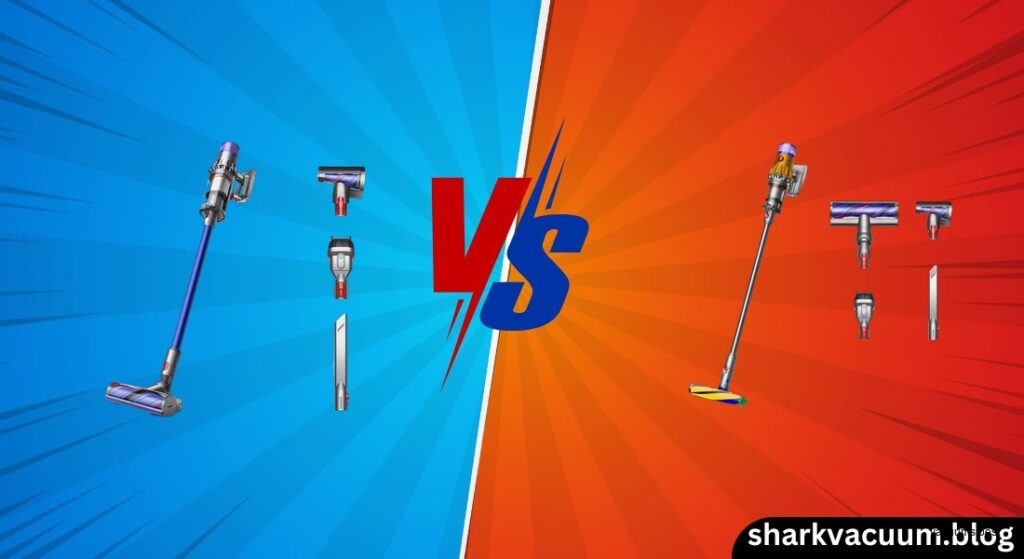
The choice between the Dyson V11 and the Dyson V12 Detect Slim isn’t just about which vacuum is “better” — it’s about which one fits your home, lifestyle, and cleaning priorities. Both are premium cordless vacuums from a brand known for innovation, but they represent two very different philosophies in Dyson’s product lineup. The V11 is the enduring powerhouse, designed for deep cleaning in carpet-heavy homes with pets. The V12 Detect Slim, on the other hand, is a sleek, lightweight evolution built for agility, smart features, and hard-floor dominance. As of 2025, with the V11’s price dropping and the V12 offering newer tech, the decision has become even more nuanced. If you’re weighing raw suction power against intelligent design and ease of use, this comparison will help you cut through the marketing and choose the right tool for your floors.
We’ll dive deep into how each model performs across real-world metrics: suction strength, carpet vs. hard floor cleaning, battery life, usability, smart features, maintenance, and value. By the end, you’ll know exactly which Dyson — the veteran V11 or the agile V12 Detect Slim — earns a spot in your home.
Product Overviews
Dyson V11: The Carpet Cleaning Workhorse
The Dyson V11, first launched in 2019, remains a benchmark for whole-home cordless vacuuming, especially in homes with significant carpeting. It’s engineered as a deep-cleaning powerhouse with a clear focus on pet owners and families dealing with embedded dirt. At its core is the Hyperdymium™ motor, spinning at 125,000 rpm to deliver up to 185 Air Watts (AW) of suction, with some marketing contexts citing up to 230 AW. This isn’t just about numbers — the aggressive Motorbar cleaner head uses stiff nylon bristles and 43 anti-tangle vanes to dig deep into carpet fibers and lift out debris that lesser vacuums leave behind.
One of the V11’s standout features is its intelligent LCD screen, which provides real-time feedback including a countdown timer, current power mode, and maintenance alerts for blockages or dirty filters. This screen is a major usability upgrade over simpler LED indicators on other models. On Absolute and Original variants, the V11 features Auto mode, which uses sensors to detect floor type and automatically adjusts suction — ramping up on carpets and scaling back on hard floors to preserve battery. However, some newer base models appear to have lost this auto-adjust feature, offering only fixed power settings, which is a notable downgrade.
The V11 runs on a removable lithium-ion battery, allowing you to swap in a spare for extended cleaning sessions. In Eco mode, it can deliver up to 60 minutes of runtime, though real-world use with motorized heads in Auto or Boost mode typically yields around 40 minutes. Its 5-stage sealed filtration system captures 99.99% of particles down to 0.3 microns, making it a solid choice for allergy sufferers.
Despite its strengths, the V11 has clear limitations. It’s heavier than its successors — estimated at around 6.8 lbs — and the pull-and-hold trigger mechanism can cause finger fatigue during long cleaning sessions. On hard floors, the Motorbar head often pushes large debris around instead of picking it up, requiring the optional Soft Roller head for optimal performance (which isn’t always included in base bundles). Perhaps most critically, the V11 jams on flat washable rugs, making it incompatible with a common household floor covering.
Check the latest price of Dyson V11 on Amazon [link]
Dyson V12 Detect Slim: The Lightweight Smart Cleaner
The Dyson V12 Detect Slim redefines what a premium cordless vacuum can be — lightweight, intelligent, and laser-focused on hard-floor performance. Weighing just 5.2 lbs, it’s significantly easier to carry upstairs, maneuver under furniture, or use for overhead cleaning. Despite its slim profile, it packs a punch with 150 Air Watts of fade-free suction, driven by the same 125,000 rpm Hyperdymium™ motor found in the V11. What sets it apart is not raw power, but smart technology and ergonomic design.
The V12’s most revolutionary feature is the Laser Slim Fluffy head, which projects a green laser at a precise angle to reveal invisible dust on hard floors — a game-changer for tile, wood, and laminate. This isn’t just a gimmick; testing shows it helps users see and remove 99.5% of debris, including fine particles like sugar and larger items like cereal. Behind the scenes, a piezo sensor counts dust particles 15,000 times per second, feeding data to an Auto mode that dynamically adjusts suction based on dust levels. This means it ramps up when it detects a mess and conserves battery on cleaner areas.
Unlike the V11, the V12 uses a one-button power switch instead of a trigger. Press once to start, press again to stop — no finger fatigue, and easier to use for those with arthritis or limited hand strength. The LCD screen displays real-time particle counts, run time, and maintenance alerts, giving users a sense of scientific validation for their cleaning.
However, these innovations come with trade-offs. The dustbin capacity is only 0.35L, roughly half the size of the V11’s, meaning frequent emptying in larger or pet-owning homes. The V12 also uses a new electrical socket design, making it incompatible with older V7 and V8 motorized tools — a major pain point for existing Dyson owners. While it performs well on low-pile carpets, it’s less effective on deep-pile rugs compared to the V11, and the higher price point (MSRP $730) feels steep for the reduced capacity.
See current deals on Dyson V12 Detect Slim here [link]
Comparison Criteria
To determine which Dyson is right for you, we’ll evaluate both models across six key criteria: suction and cleaning performance, design and ergonomics, smart features and intelligence, battery and runtime, maintenance and durability, and value for money. These categories reflect real-world usage, not just spec sheets. We’ll look at how each vacuum handles different floor types, how comfortable it is to use over time, how its technology enhances (or complicates) cleaning, and whether the price justifies the features.
The goal isn’t to crown a single “best” vacuum, but to identify which model aligns with your specific needs. A pet owner with wall-to-wall carpeting has different priorities than a city dweller with hardwood floors and mobility concerns. By breaking down the comparison across these measurable and experiential dimensions, we can move beyond subjective preferences and make a data-driven recommendation.
Head-to-Head Comparison
Suction Power & Cleaning Performance
When it comes to raw cleaning power, the Dyson V11 has the edge — but the gap isn’t as wide as the numbers suggest.
The V11’s 185 AW (up to 230 AW in marketing claims) provides superior agitation on carpets, especially medium to high-pile. Its Motorbar head delivers deep cleaning by driving bristles into the fibers and lifting embedded dirt, pet dander, and large debris like cereal or oatmeal with ease. Independent testing confirms it outperforms the V12 on thick carpets, particularly with fine powders like sugar, where the V12 leaves a slight residue. The V11’s larger bin also means it can handle longer cleaning sessions without needing to stop and empty.
Pro Tip: If you have deep-pile carpeting or a heavy-shedding pet, the V11’s combination of higher suction, aggressive brushroll, and larger bin makes it the more practical choice for a thorough clean.
On hard floors, however, the story flips. The V11’s standard Motorbar head struggles with large debris, often pushing items like rice or rolled oats across the floor instead of picking them up. While it can be paired with the Soft Roller head (available on Absolute models or sold separately), many current base models don’t include it, leaving users with subpar hard-floor performance out of the box.
The Dyson V12 Detect Slim excels here. Its Laser Slim Fluffy head is a revelation — the angled green laser illuminates invisible dust along baseboards and under furniture, while the soft carbon fiber and nylon filaments lift fine particles without scattering them. Testing shows it captures 99.5% of debris on hardwood, including both fine dust and large particles. The piezo sensor ensures suction adjusts in real time, so it doesn’t waste battery on clean areas.
For pet hair, both models perform well thanks to Dyson’s anti-tangle technology. The V11’s 43-vane Motorbar and Hair Screw Tool are excellent at preventing hair wrap, and the larger bin is better for heavy shedding. The V12’s Motorbar also resists tangling, and its Hair Screw Tool (included in bundles) is equally effective. However, the V12’s small bin means more frequent emptying in pet-heavy homes.
🏆 Section Winner: Dyson V11 for overall suction and carpet performance.
While the V12 is no slouch, the V11’s superior deep-cleaning power and larger debris capacity make it the better all-around performer in homes with significant carpeting.
Design, Weight, and Usability
This is where the Dyson V12 Detect Slim pulls ahead decisively.
At just 5.2 lbs, the V12 is significantly lighter than the V11 (estimated at ~6.8 lbs). That difference is immediately noticeable when cleaning stairs, reaching under furniture, or using the vacuum in handheld mode. The V12’s slim profile also allows it to lay nearly flat, making it easier to clean under sofas and beds. For users with mobility issues, arthritis, or those who hate the fatigue of heavier vacuums, the V12 is a breath of fresh air.
The control mechanism is another major differentiator. The V11 uses a pull-and-hold trigger, which requires constant finger pressure. Over a 20-minute clean, this can lead to hand fatigue. The V12 replaces this with a simple push-button power switch — press once to start, press again to stop. This eliminates finger strain and makes it easier to swap hands or use while navigating obstacles.
However, the V12’s 0.35L dustbin is a major limitation. It’s roughly half the capacity of the V11’s bin (0.76L implied), meaning you’ll need to empty it twice as often during a whole-home clean. This is especially true in homes with pets or high foot traffic. While the hygienic “point and shoot” emptying design minimizes contact with dust, the frequent stops disrupt cleaning flow.
Noise levels also favor the V12. It operates between 53–59 dB, comparable to a refrigerator, while the V11 is noticeably louder, especially in Boost mode. The quieter operation makes the V12 less intrusive in shared living spaces or apartments.
🏆 Section Winner: Dyson V12 Detect Slim
Its lightweight design, button control, and quiet operation make it far more user-friendly, especially for everyday cleaning and users with physical limitations.
Intelligence and Features
Both vacuums feature LCD screens and smart sensors, but their implementations differ.
The V11’s LCD displays remaining runtime to the second, current power mode, and maintenance alerts for blockages or dirty filters. This real-time feedback is highly practical, especially the accurate run-time countdown, which helps plan cleaning sessions. On models with Auto mode, it also indicates when the vacuum detects a carpet and increases suction. However, this feature is missing on some newer base models, reducing its “smart” appeal.
The V12’s LCD goes further by showing a graphical particle count, categorizing dust by size (micro, medium, macro). While visually impressive, this data is largely novelty — it doesn’t integrate with an app or provide long-term cleaning insights. The real intelligence lies in the piezo sensor, which counts particles 15,000 times per second and powers the Auto mode. This system is more responsive than the V11’s floor-resistance detection, adjusting suction based on actual dust levels rather than surface type.
The laser dust detection on the V12’s Fluffy head is a tangible advantage. It reveals twice as much invisible dust as standard lighting, helping users clean more thoroughly. The V11 lacks this feature unless paired with a rare laser-equipped tool (not standard on current models).
🏆 Section Winner: Dyson V12 Detect Slim
Its laser visibility, responsive auto-suction, and particle sensing offer a more advanced, interactive cleaning experience — even if some features are more flashy than functional.
Battery Life
Battery performance is surprisingly close, but the V11 has a slight edge in real-world use.
Both vacuums claim up to 60 minutes of runtime in Eco mode, but this is typically achieved only with non-motorized tools. When using motorized heads (the most common scenario), the numbers drop.
Testing shows the V12 delivers about 33 minutes in Auto/Medium mode with the Motorbar head — enough for a small apartment but tight for a larger home. The V11 offers closer to 40 minutes in Auto mode, giving it a practical advantage for whole-home cleaning.
Both take approximately 4 hours to charge and feature swappable batteries, allowing for extended cleaning with a spare. This modularity is a key benefit of the Dyson ecosystem.
While the V12’s Auto mode is more efficient at adjusting suction, the V11’s larger battery capacity and slightly better power management give it a longer usable runtime in mixed-floor environments.
🏆 Section Winner: Dyson V11
It offers more consistent, longer runtime in real-world cleaning scenarios, especially when using motorized tools.
Maintenance and Durability
Both vacuums require similar maintenance: monthly filter washing and regular bin emptying. The filters are washable and must dry for at least 24 hours before reinsertion to prevent motor damage.
The V12’s small bin (0.35L) means more frequent emptying, which can become tedious in larger homes or pet-owning households. The V11’s larger bin reduces this chore significantly.
Brush roll maintenance is similar on both. The anti-tangle technology works well, but hair and fibers can still wrap around the heads over time, requiring manual cleaning. The V12’s Motorbar features polycarbonate vanes that help lift hair into the bin, reducing wrap.
A major differentiator is tool compatibility. The V12 uses a new electrical socket design that is incompatible with V7 and V8 motorized heads. This is a significant drawback for existing Dyson owners who’ve invested in tools. The V11 maintains backward compatibility with most non-electric accessories (crevice, dusting brush), though it can’t use the newest V12-specific motorized heads.
Durability-wise, both are built from tough, lightweight materials. The V11 has a proven track record, while the V12’s lighter construction may feel less robust to some users, though service data suggests it’s reliable.
🏆 Section Winner: Dyson V11
Its larger bin and broader tool compatibility make it easier and more cost-effective to maintain over time.
Value for Money
This is where personal priorities matter most.
The Dyson V11 typically sells for $570–$660, down from its original price. For that, you get superior carpet cleaning, longer battery life, a larger bin, and broader accessory compatibility. It’s a practical, whole-home workhorse that delivers excellent value for homes with pets and carpets.
The Dyson V12 Detect Slim has an MSRP of $730, though it’s often discounted to around $500–$600. For that price, you get lightweight agility, laser dust detection, smart particle sensing, and a button control — but with half the bin capacity and limited motorized tool compatibility. It feels like a premium product with compromises.
For hard-floor dominant homes, apartments, or users with mobility concerns, the V12’s innovations justify the cost. But for larger homes or carpet-heavy environments, the V11 offers better overall value.
🏆 Section Winner: Dyson V11
It delivers more cleaning capacity and performance for the price, making it the better long-term investment for most households.
Pros and Cons Table
| Feature | Dyson V11 | Dyson V12 Detect Slim |
|---|---|---|
| Best For | Carpet-heavy homes, Pet owners, Large debris | Hard floors, Apartments, Mobility-limited users |
| Suction Power | High (Up to 185-230 AW) | Moderate-High (150 AW) |
| Weight | Heavier (~6.8 lbs estimate) | Ultra-light (5.2 lbs) |
| Bin Capacity | Larger (Better for whole home) | Small (0.35L – frequent emptying) |
| Hard Floor Tech | Good (with extra Soft Roller) | Excellent (Laser + Fluffy standard) |
| Carpet Performance | Excellent (Deep agitation) | Good (Struggles on high pile/fine dust) |
| Control | Trigger (Hold to run) | Power Button (Push to run) |
| Smart Features | LCD Countdown, Auto-mode (select models) | Particle Counter, Laser, Auto-mode |
| Tool Compatibility | Broad (Legacy non-motorized) | Limited (New socket design) |
| Price Point | Mid-High (~$570 – $660) | High (~$730 MSRP, often discounted) |
| Major Con | Can jam on flat rugs; Trigger fatigue | Tiny bin; Expensive for the size |
Best Use Case Recommendation
Choose the Dyson V11 If:
- Your home is mostly carpeted: The V11’s superior agitation and suction depth make it the undisputed king of carpets in this comparison. It lifts embedded dirt and pet hair more effectively than the V12.
- You have pets that shed heavily: The larger bin capacity means fewer interruptions to empty hair and dander, making it more practical for daily use in pet-owning homes.
- You need deep cleaning power: If you prioritize raw cleaning force over weight and smart sensors, the V11 delivers a more thorough clean, especially on high-pile rugs.
- Budget is a consideration: The V11 is often found at lower price points than the V12, especially the base models, offering better value for the performance.
Choose the Dyson V12 Detect Slim If:
- You have primarily hard floors: The Laser Fluffy head is a game-changer for tile, wood, and laminate, revealing and capturing invisible dust that most vacuums miss.
- Mobility or weight is a concern: At 5.2 lbs, it’s ideal for seniors, those with arthritis (thanks to the button control), or multi-story homes where carrying weight up stairs is an issue.
- You live in an apartment or small home: The small bin is less of a problem in smaller spaces, and the quiet operation is a plus in shared buildings.
- You love tech: The particle counter and automatic suction adjustment provide a modern, interactive cleaning experience that feels futuristic, even if not always essential.
View Dyson V11 vs V12 on Amazon [link]
Conclusion
The Dyson V11 and Dyson V12 Detect Slim represent two distinct visions of what a premium cordless vacuum should be. The V11 is the rugged, high-capacity workhorse — a performance purist’s choice for homes with carpets and pets. It offers longer battery life, a larger bin, superior carpet cleaning, and better tool compatibility, all at a more competitive price. While it’s heavier and uses a trigger that can cause fatigue, its strengths in deep cleaning make it a practical, long-term investment for many households.
The V12 Detect Slim, in contrast, is the agility seeker’s dream — a lightweight, intelligent cleaner built for hard floors and ease of use. Its laser dust detection, button control, and quiet operation make it ideal for apartments, smaller homes, and users with mobility concerns. However, its tiny bin and high price make it feel like a premium product with compromises, especially for larger homes or heavy shedders.
Final Verdict:
* For performance purists with mixed or carpeted floors: Dyson V11 is the winner.
* For agility seekers with hard floors and smaller spaces: Dyson V12 Detect Slim takes the crown.
While the V12 feels more advanced, the V11 often delivers a more thorough “whole home” clean due to its capacity and power. In the world of premium vacuums, newer isn’t always better — it’s just different. Your floor type, lifestyle, and priorities will determine which Dyson truly wins for you in 2025.