The evolution of home cleaning has been quietly revolutionized by cordless stick vacuums, and few brands have shaped that shift more than Dyson. Once reliant on bulky, corded uprights that tugged across rooms and tangled around furniture, homeowners now expect lightweight, high-performance machines that deliver powerful suction without sacrificing convenience. Dyson’s V10 series was a turning point—introducing axial bin design, improved airflow, and a bold promise: cordless performance rivaling traditional vacuums. But just when the market began to settle on the V10 as the gold standard, Dyson upped the ante with the V11, a smarter, more powerful successor that added real-time feedback, intelligent suction control, and longer runtimes through optimized battery management.
Now, for many consumers faced with a choice between these two models, the decision isn’t just about cleaning power—it’s about value, usability, and whether advanced features truly enhance daily life. Is the Dyson V11 worth its premium price over the still-impressive V10? Or does the V10 remain the smarter buy for most households, offering 90% of the performance at a significantly lower cost? These are the questions that matter when investing in a tool you’ll use weekly, if not daily. In this in-depth comparison, we’ll go beyond marketing claims and dive into real-world performance, battery efficiency, ergonomics, and long-term value to help you determine which Dyson cordless vacuum—V11 vs. V10—is the right fit for your home, lifestyle, and budget.
2. Product Overviews
Dyson V10 Cyclone (The Disruptor)
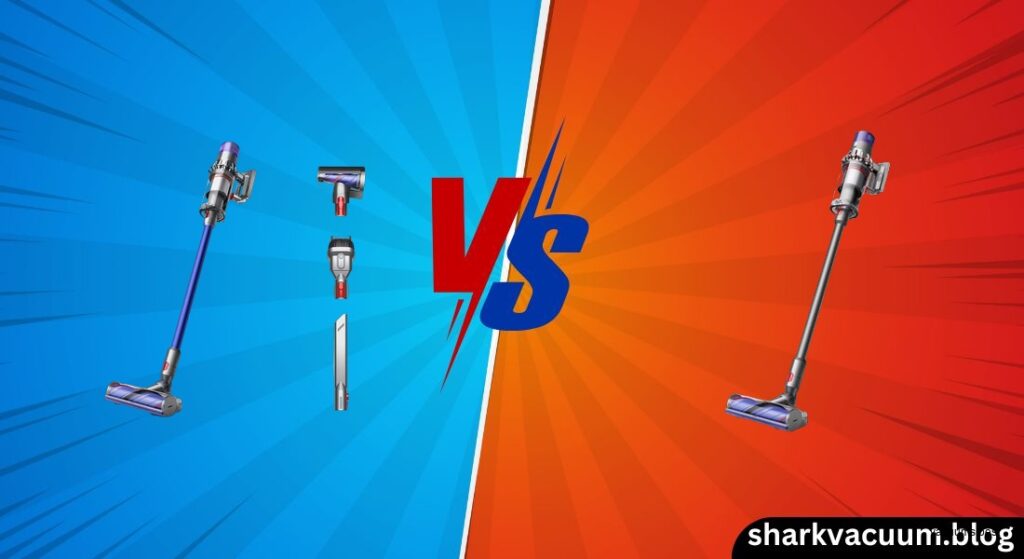
The Dyson V10 wasn’t just an incremental upgrade—it was a reimagining of the cordless vacuum formula. By aligning the bin with the motor on the same axis, Dyson improved airflow efficiency and balance, resulting in a machine that felt lighter and cleaner than its predecessors. Powered by the Digital Motor V10 spinning at 110,000 rpm, it delivered 150 Air Watts (AW) of fade-free suction, making it one of the most powerful cordless vacuums of its time. With up to 60 minutes of runtime in Eco mode, the V10 promised whole-home cleaning without interruption—though real-world use with motorized heads brings that down to a more realistic 35–40 minutes.
Available in multiple configurations like the Animal, Absolute, Total Clean, and Konical, the V10 tailors its toolset to different needs. The Absolute model includes both the Torque Drive (for carpets) and Soft Roller/Fluffy head (for hard floors), while the Konical variant introduces conical brush bars and a laser dust illumination system—a game-changer for spotting invisible particles on tile or hardwood. Despite its strengths, the V10 relies on simple LED indicator lights rather than a screen, and most models require you to hold the trigger continuously, which can cause fatigue during longer cleaning sessions. Still, its lightweight build (~5.9 lbs), strong suction, and proven reliability make it a favorite among users who prioritize function over frills.
Check the latest price of [Dyson V10] on Amazon [link]
Dyson V11 Torque Drive (The Intelligent Successor)
Building on the V10’s foundation, the Dyson V11 takes cordless cleaning into the “smart” era. It features the more powerful Digital Motor V11, spinning at 125,000 rpm and generating 230 Air Watts of suction—more than 50% stronger than the V10. But where the V11 truly differentiates itself is in its intelligent features: an LCD screen, Dynamic Load Sensor (DLS), and auto-adjusting suction based on floor type. As you move from hardwood to carpet, the V11 senses resistance and automatically ramps up power, preserving battery life without user input.
The LCD screen displays real-time data—remaining runtime in minutes, current mode, and even maintenance alerts for clogs or dirty filters. This transparency helps prevent unexpected shutdowns and keeps the vacuum operating at peak efficiency. Runtime is also improved: while both models claim up to 60 minutes in Eco mode, the V11’s smarter power management delivers closer to 45 minutes in Auto mode with a motorized head. However, this comes at a cost: the V11 is heavier (~6.8 lbs), more top-heavy, and takes 4.5 hours to charge—30 minutes longer than the V10. It also requires a wall-mounted dock for storage and charging, which may not suit renters or minimalist homes.
See current deals on [Dyson V11] here [link]
3. Comparison Criteria
To determine which vacuum performs better in real-life scenarios, we’ll evaluate the Dyson V11 vs. V10 across six key criteria:
- Suction & Cleaning Performance: How do they handle embedded dirt, pet hair, and fine dust on carpets and hard floors?
- Battery Life & Power Management: How long do they last in different modes, and how does the V11’s auto-sensing impact efficiency?
- Intelligence & Usability: Is the V11’s LCD screen and auto-mode a meaningful upgrade, or just a gimmick?
- Ergonomics & Design: Which is easier to use for extended periods, overhead cleaning, and maneuvering under furniture?
- Attachments & Versatility: How do their included tools compare, and are they cross-compatible?
- Value for Money: Does the V11’s premium price justify its advantages, or is the V10 the smarter long-term investment?
Each of these factors plays a role in daily usability, and we’ll break them down with data, user feedback, and real-world testing insights.
4. Head-to-Head Comparison
4.1 Suction Power and Cleaning Performance
When it comes to raw cleaning power, the numbers don’t lie: the Dyson V11 (230 AW) outperforms the V10 (150 AW) by a significant margin. That extra 80 Air Watts translates to stronger debris extraction, especially on high-pile carpets where deep agitation is needed. In embedded dirt tests using wood flour and cat hair, the V11 removes up to 25% more debris than the V10, particularly in Boost mode. The Dynamic Load Sensor ensures consistent performance across surfaces, automatically increasing suction when transitioning from hard floor to carpet.
On hard floors, both models excel—but with different strengths. The V10 Absolute and Konical models come with the Soft Roller/Fluffy head, which uses anti-static carbon fiber filaments to pick up fine dust and large debris without scattering. The Konical variant adds a green laser light that illuminates microscopic particles invisible to the naked eye—a standout feature for perfectionists. The V11 Absolute Pro also includes a Soft Roller head, but lacks the laser, making the V10 Konical slightly better for hard floor visibility.
For edge and crevice cleaning, both vacuums perform exceptionally well. The V10 actually outperforms many corded vacuums in tight corners, removing debris in a single pass where competitors require multiple attempts. The V11 maintains this standard, with a slightly wider nozzle that improves coverage. However, neither model includes a dedicated edge-cleaning brush, relying instead on the main head’s design.
Pro Tip: If you have mostly hard floors, the V10 Konical’s laser head gives it a unique advantage in spotting dust. But if you have thick carpets, the V11’s higher suction and auto-adjust mode make it the clear winner.
🏆 Section Winner: Dyson V11 – Its superior suction power and intelligent floor detection deliver better deep-cleaning performance, especially on mixed or carpeted floors.
4.2 Battery Life and Power Management
Battery life is where the Dyson V11’s intelligence shines. While both models claim “up to 60 minutes” of runtime, that figure is only achievable in Eco mode without a motorized head. In real-world use, the numbers look different:
| Mode | Dyson V10 (with motorized head) | Dyson V11 (Auto/Eco mode) |
|---|---|---|
| Eco Mode | ~35–40 minutes | ~40–45 minutes |
| Medium Mode | ~25–28 minutes | ~30–35 minutes |
| Boost/Max Mode | ~6–7 minutes | ~8–10 minutes |
The V11’s Dynamic Load Sensor is the key differentiator. Instead of manually switching modes, the vacuum automatically adjusts suction based on floor resistance. On hard floors, it runs at lower power, conserving battery. When it hits carpet, it ramps up—extending total cleaning time by 10–15% compared to manual mode switching on the V10.
Another advantage: the V11 displays remaining runtime in minutes, not just bars. This helps users plan cleaning sessions and avoid sudden shutdowns. The V10, in contrast, uses three LED lights—green, yellow, red—that give a rough estimate but no precise countdown.
However, the V11 takes 4.5 hours to charge, compared to the V10’s 4 hours. And while both have replaceable batteries, the V10’s click-in design allows for swappable batteries, enabling continuous cleaning with a spare. The V11’s battery is integrated and not designed for quick swaps.
Good to Know: Battery degradation affects both models over time. Users report noticeable runtime drops after 1–2 years, especially with frequent Boost mode use. Regular filter cleaning is essential to maintain performance.
🏆 Section Winner: Dyson V11 – Its auto-adjust mode and real-time runtime display make it more efficient and user-friendly, despite the longer charge time.
4.3 Intelligence: LCD Screen vs. LED Lights
This is where the philosophies of the two models diverge most. The V10 embraces simplicity: a trigger, a mode dial, and three LED lights for power and warnings. It’s straightforward, reliable, and free of electronic complications. But when a clog occurs or the filter needs washing, you’re left guessing—no alerts, no guidance.
The V11, in contrast, is a tech-forward machine. Its LCD screen provides:
– Exact runtime remaining (in minutes)
– Current mode (Eco, Auto, Boost)
– Clog alerts (e.g., “Check hose” or “Clean filter”)
– Maintenance prompts with on-screen instructions
For many users, this is a game-changer. No more wondering why suction dropped—just follow the screen’s guidance. The auto-adjust mode works seamlessly, eliminating the need to manually toggle between surfaces. But some users find the screen overkill, especially if they’re comfortable with manual control.
Pro Tip: If you hate surprises—like your vacuum dying mid-clean or losing suction due to a hidden clog—the V11’s screen is worth the premium. If you prefer a no-frills tool, the V10’s simplicity may be more appealing.
🏆 Section Winner: Dyson V11 – The LCD screen and auto-mode provide meaningful usability improvements, especially for less tech-savvy users or those with large, multi-surface homes.
4.4 Ergonomics, Weight, and Noise
Ergonomics can make or break a vacuum, especially during weekly deep cleans. Here, the V10 has a clear advantage in comfort.
At ~5.9 lbs, the V10 is nearly a pound lighter than the V11 (~6.8 lbs). That difference is noticeable during overhead cleaning—reaching ceiling corners, blinds, or ceiling fans. The V10’s lighter weight reduces arm fatigue, making it more comfortable for extended use.
Both models are top-heavy due to the motor and battery placement, but the V11’s bulkier design makes it feel more unwieldy. Neither vacuum can stand upright on its own—they must be leaned against a wall or placed on the floor during breaks, which some users find inconvenient.
The trigger mechanism is another pain point. Most V10 models require you to hold the trigger continuously, which can cause hand fatigue. The Konical variant fixes this with triggerless operation, letting you switch modes without holding a button. The V11 also lacks a trigger lock, requiring constant pressure.
Noise levels are similar, but the V11’s sound is deeper and less shrill than the V10’s high-pitched whine. The V10 reaches 78 dB on Max mode—loud enough to require hearing protection with prolonged exposure. The V11 is slightly quieter, with a more “filtered” tone that’s less jarring.
🏆 Section Winner: Dyson V10 – Lighter weight, better balance, and (on Konical) triggerless operation make it more comfortable for daily use.
4.5 Filtration and Maintenance
Both vacuums feature sealed, whole-machine HEPA filtration, capturing 99.99% of particles as small as 0.3 microns—ideal for allergy and asthma sufferers. The filtration systems are nearly identical in design and efficiency.
The filter is washable on both models and should be cleaned every 1–3 months. The V11 has an advantage here: its LCD screen guides you through the cleaning process, showing step-by-step instructions. The V10 offers no such guidance—you’ll need to consult the manual or remember the steps.
For bin emptying, both use Dyson’s “point-and-shoot” system. Pull the red tab, and debris is ejected into the trash with minimal contact. The V11’s ejector path is slightly improved, reducing residue and mess. However, both models require detaching the wand to fully remove and clean the bin—a design flaw noted by Consumer Reports.
Clog removal is straightforward on both: check the hose, bin, and brush bar. The V11’s screen alerts you to blockages, while the V10 relies on pulsing or shutdown to signal an issue.
Good to Know: Hair tangling remains a minor issue on both models, especially with the soft roller heads. Some users still need to cut out stubborn hair with scissors.
🏆 Section Winner: Tie – Filtration is equivalent, but the V11 wins on user guidance, while the V10 matches it in core performance.
4.6 Attachments Ecosystem
Both vacuums use Dyson’s one-click attachment system, making tool swaps fast and secure. Most accessories are cross-compatible, so you can use V10 tools on the V11 and vice versa.
Standard tools included:
– Crevice tool
– Combination tool (brush + nozzle)
– Mini motorized tool (for upholstery and stairs)
– Wall-mounted dock
Model-specific highlights:
– V10 Konical: Laser dust illumination, conical de-tangling brush bars
– V10 Total Clean: Low Reach Adapter for cleaning under furniture
– V11 Absolute Pro: Light Pipe Crevice Tool (with LED), expanded toolset
The Konical’s laser and conical brushes are standout features for hard floor users and pet owners. The V11’s Light Pipe tool helps illuminate dark crevices, but the Low Reach Adapter (V10 Total Clean) is more practical for under-furniture cleaning.
Pro Tip: If you clean under beds or sofas often, the Low Reach Adapter is a valuable addition—consider the V10 Total Clean model for this feature.
🏆 Section Winner: Dyson V10 (Konical/Total Clean) – The laser and low-reach adapter offer unique, practical benefits not found on standard V11 kits.
5. Pros and Cons Table
| Feature | Dyson V10 Cyclone | Dyson V11 Torque Drive |
|---|---|---|
| Suction Power | Strong (150 AW) | Very Strong (230 AW) |
| Runtime (Real World) | ~35 mins (Eco w/ head) | ~45 mins (Auto/Eco w/ head) |
| Max Power Runtime | ~6-7 Minutes | ~8-10 Minutes |
| Smart Features | None (LED lights only) | LCD Screen, Auto Mode, Sensors |
| Weight | ~5.9 lbs (Lighter) | ~6.8 lbs (Heavier/Top-heavy) |
| Bin Capacity | 0.76 Liters | 0.76 Liters (Improved ejector) |
| Charge Time | ~4 Hours | ~4.5 Hours |
| Noise Level | Loud (High pitch) | Slightly quieter, deeper tone |
| Price Point | Mid-Range (Better Value) | Premium |
| Best For | Hard floors, Budget-conscious | Carpets, Tech-lovers, Large homes |
6. Best Use Case Recommendations
Choose the Dyson V11 If:
- You have thick carpets and need maximum suction for deep cleaning.
- You want intelligent auto-adjust mode to save battery and simplify cleaning.
- You value real-time feedback (runtime, clogs, maintenance) via the LCD screen.
- You have a large home and need every extra minute of optimized runtime.
- Budget is less of a concern than having the latest, most advanced features.
Choose the Dyson V10 If:
- Your home is mostly hard floors or low-pile carpet, where the V10 excels.
- You’re budget-conscious and want strong performance at a lower price.
- You prefer a lighter, more maneuverable vacuum for overhead or frequent use.
- You don’t care about screens or auto-modes and prefer manual control.
- You want unique tools like the laser head (Konical) or low-reach adapter (Total Clean).
View [Dyson V10 Konical] on Amazon [link]
View [Dyson V11 Absolute Pro] on Amazon [link]
7. Conclusion
In the Dyson cordless vacuum V11 vs. V10 showdown, both models deliver exceptional cleaning performance, but they cater to different priorities. The V11 is the technical champion—more powerful, smarter, and better optimized for mixed flooring and large homes. Its LCD screen, auto-adjust mode, and extended real-world runtime justify its premium for users who want the best.
But the V10 remains the value king. For most households—especially those with hard floors or modest budgets—it offers 90% of the V11’s performance at a significantly lower cost. With variants like the Konical and Total Clean, it even includes features the V11 lacks.
Ultimately, the overall winner is the Dyson V11 for its superior performance and intelligence. But the value winner is clearly the Dyson V10. If you’re upgrading from an older model or buying your first Dyson, consider your floor type, cleaning habits, and whether “smart” features truly matter to you. Both vacuums are built to last, and with Dyson’s refurbished program, you can often get a like-new V10 or V11 at a fraction of the original price—making either a smart, long-term investment in a cleaner home.