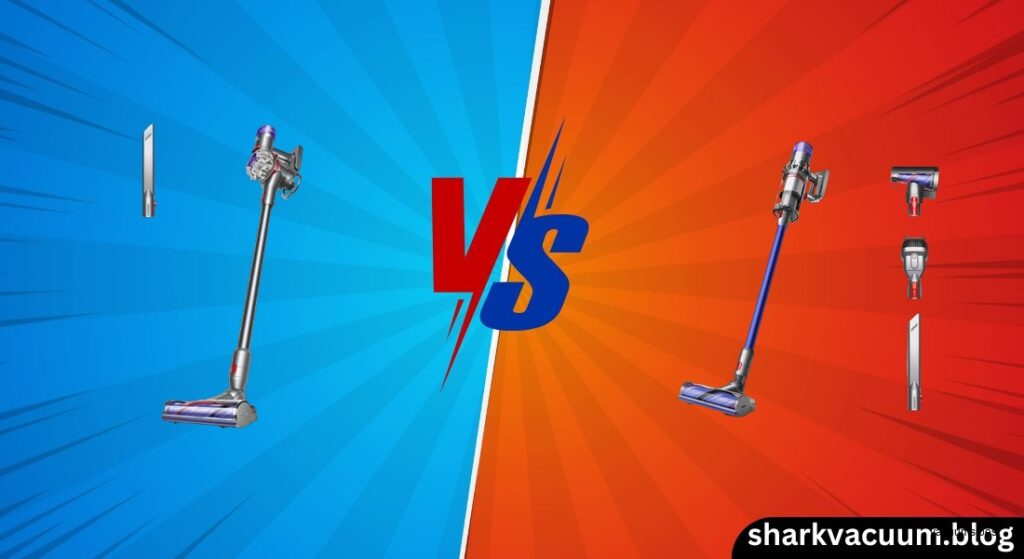
The cordless vacuum market is dominated by Dyson, but choosing between their generations can be confusing. This article compares two of the brand’s most popular models: the Dyson V8 and the Dyson V11.
While the V8 remains a best-seller known for its lightweight versatility and excellent value, the V11 represents a technological leap with a digital interface, significantly higher suction power, and intelligent cleaning modes. Both are engineered for homes with pets and mixed flooring, but they cater to different user priorities regarding budget, tech features, and floor types. This guide breaks down exactly how they compare to help you decide which machine deserves a spot in your cleaning closet.
Dyson V8 vs. Dyson V11: Product Overviews
Dyson V8 (The Reliable Workhorse)
The Dyson V8 is the established standard for cordless cleaning. Powered by the Digital Motor V8, it offers a balanced approach to cleaning with 115 Air Watts of suction.
Key Features: 40-minute runtime, 15 cyclones for consistent suction, HEPA filtration, and a lightweight design (5.82 lbs).
Strengths: Exceptionally lightweight, includes the “Fluffy” soft roller head (on Absolute models) which is superior for hard floors, and generally more affordable.
Weaknesses:* Lacks an LCD screen (uses simple LED lights), lower suction power compared to newer models, and a fixed trigger that requires holding (on some variations) or lacks auto-adjustment.
Check the latest price of [Dyson V8] on Amazon [link]
Dyson V11 (The Intelligent Powerhouse)
The Dyson V11 is the successor designed for whole-home deep cleaning, boasting a 60% power increase over the V8. It introduces the Hyperdymium motor and a suite of smart features.
Key Features: 185 Air Watts of suction (Boost mode), LCD screen with real-time diagnostics, Auto mode (adjusts to floor type), and up to 60 minutes of runtime in Eco mode.
Strengths: Massive suction power, intelligent battery management, real-time maintenance alerts, and superior carpet deep-cleaning capabilities.
Weaknesses:* Heavier (6.6 lbs), struggles with flat washable rugs (jamming issue), fixed-height motorbar head can push large debris on hard floors, and a significantly higher price point.
View [Dyson V11] on Amazon [link]
Comparison Criteria
To determine the winner, we evaluated both vacuums based on the following metrics, tailored to the cordless stick vacuum niche:
1. Suction & Cleaning Performance: Raw power and effectiveness on carpets vs. hard floors.
2. Battery Life & Management: Runtime consistency, charging time, and intelligent power saving.
3. Design & Ergonomics: Weight, balance, bin emptying, and user interface (LCD vs. LEDs).
4. Filtration & Hygiene: Ability to trap allergens and ease of maintenance.
5. Accessories & Versatility: Tool quality and floor head adaptability.
6. Value & Reliability: Price-to-performance ratio and long-term durability data.
Head-to-Head Comparison
Suction and Floor Performance
When it comes to raw cleaning power, the Dyson V11 pulls ahead with 185 Air Watts in Boost mode—60% more than the V8’s 115 Air Watts. This difference is most noticeable on carpets, where the V11 digs deeper into fibers to extract embedded dirt, pet hair, and fine debris like flour or oats. Its Motorbar™ cleaner head uses stiff nylon bristles and 43 anti-tangle vanes to maintain consistent contact with plush or high-pile rugs, earning top marks in lab tests for deep-cleaning performance.
On hard floors, however, the Dyson V8 Absolute often outperforms the V11—but only if it includes the Fluffy™ soft roller head. This specialized head features anti-static carbon fiber filaments and soft woven nylon that simultaneously captures both fine dust and larger debris like cereal or crumbs without scattering them. In contrast, the V11’s standard Motorbar head has a fixed height, which prevents it from lying flush on hard surfaces. As a result, it tends to push larger particles across the floor rather than suck them up.
Another major flaw of the V11 is its incompatibility with flat washable rugs. Due to the aggressive beater bar action, these thin rugs often get sucked up into the cleaner head and jam the mechanism—a well-documented issue with no official fix from Dyson. The V8 doesn’t suffer from this problem to the same degree, making it more reliable for homes using such rugs.
For pet owners, both models are excellent thanks to Dyson’s anti-tangle technology. The V11’s Hair Screw tool and Motorbar head are slightly more aggressive, especially for long-haired pets, but the V8’s de-tangling vanes are also highly effective for everyday use.
🏆 Section Winner: Dyson V11 for carpets, Dyson V8 Absolute for hard floors
Why: The V11 dominates on carpets with superior suction and deep-cleaning ability, while the V8 Absolute wins on hard floors thanks to the Fluffy head’s superior debris capture.
Battery Life and Intelligence
Battery life is a critical factor in cordless vacuums, and here the V11 offers a clear advantage. It provides up to 60 minutes of runtime in Eco mode, compared to the V8’s 40 minutes. However, this gap narrows significantly in high-power modes—Boost mode drains the V11 battery 8 times faster than Eco mode, meaning actual runtime under heavy use may be as short as 5–8 minutes. The V8, while starting with less capacity, behaves similarly in MAX mode.
Where the V11 truly shines is battery intelligence. Its LCD screen displays remaining runtime down to the second and automatically switches between power modes in Auto mode (available on Torque Drive and Animal models). This sensor-driven system detects floor resistance and adjusts suction accordingly—perfect for moving between carpet and hard floors without manual input.
The V8, by comparison, relies on three LED dots to estimate battery life. These provide only a rough approximation and don’t account for usage patterns. There’s no Auto mode, so you must manually switch between Standard and MAX modes, leading to battery anxiety—especially when cleaning large homes.
Both vacuums take about the same time to charge: 5 hours for the V8, 4 hours for the V11. The V11 also supports removable batteries (sold separately), allowing for extended cleaning sessions—a feature the V8 lacks.
🏆 Section Winner: Dyson V11
Why: The combination of longer runtime, real-time battery countdown, and Auto mode makes the V11 far more intelligent and user-friendly for whole-home cleaning.
Design, Weight, and Usability
At 5.82 lbs, the Dyson V8 is noticeably lighter than the V11, which weighs 6.6 lbs. That extra pound may not sound like much, but it becomes apparent during extended cleaning sessions, especially when using the vacuum in handheld mode for stairs, upholstery, or car interiors. The V8’s lighter frame makes it easier to maneuver and less tiring to use over time.
Both models feature a pull-and-hold trigger, meaning you must keep your finger on the switch to maintain suction. Neither has a lockable trigger, which can lead to hand fatigue—particularly on the V11 during long Boost mode sessions.
The user interface is another major differentiator. The V11’s LCD screen provides actionable feedback: it shows cleaning mode, exact runtime, and even pinpoints blockages (e.g., “Check filter” or “Clear wand”). The V8 uses blinking LED lights that require you to consult the manual to interpret—less intuitive and less helpful when troubleshooting mid-clean.
Bin emptying is nearly identical on both models, with Dyson’s “point-and-shoot” hygienic ejection system. However, the V11’s bin is slightly larger (0.14 gallon vs. V8’s 0.14 gallon—though sources vary slightly), meaning fewer trips to the trash can during heavy cleaning.
One ergonomic downside of the V11 is its lack of a self-standing feature—it must be hung on the dock or leaned against a wall. The V8 faces the same limitation.
🏆 Section Winner: Dyson V8
Why: The lighter weight and better balance make the V8 more comfortable for above-floor cleaning and extended use.
Filtration and Maintenance
Both the V8 and V11 use fully sealed HEPA-grade filtration systems that capture 99.97% to 99.99% of particles as small as 0.3 microns—including pet dander, pollen, and dust mites. In MAX or Boost mode, the V11 reaches 99.99% efficiency, making it slightly better for allergy sufferers.
Filtration is equally effective on both models when maintained properly. The key difference lies in how they alert you to maintenance needs.
The V11’s LCD screen displays clear messages like “Wash filter” or “Check for blockages,” often with visual icons showing exactly where the issue is. This reduces guesswork and helps prevent performance loss.
The V8, lacking a screen, relies on pulsing sounds, blinking lights, or a drop in suction to signal problems. While functional, this system is less precise and can lead to delayed maintenance.
Both models require the filter to be washed monthly and left to dry for at least 24 hours before reinsertion. Using a wet filter can damage the motor or cause the vacuum to shut off.
Replacement filters are available: $11.99 for the V8, $19.99 for the V11. Battery replacement costs $129.99 for both.
🏆 Section Winner: Dyson V11
Why: The real-time maintenance alerts make it easier to keep the vacuum running at peak performance.
Accessories and Versatility
Accessories play a big role in a vacuum’s versatility, and the Dyson V8 Absolute edges out the V11 in floor head flexibility.
The V8 Absolute typically includes:
– Motorbar™ head (for carpets and hard floors)
– Fluffy™ soft roller head (optimized for hard floors)
– Hair Screw tool, crevice tool, combination tool, and docking station
The Fluffy head is a game-changer for hardwood, tile, and laminate—it picks up large debris and fine dust without scattering or scratching.
In contrast, the standard Dyson V11 comes with only the Motorbar™ head, which, as discussed, isn’t ideal for hard floors. Some higher-end V11 models (like the Absolute variant) include the Fluffy head, but these are less common and more expensive.
The V11 does offer better tool expansion, especially in the V11 Extra model, which includes 11 accessories like the Stubborn Dirt Brush, Up-top Adaptor, and Extension Hose. These tools enhance cleaning in tight spaces, on ceilings, and for delicate surfaces.
Both models include the Hair Screw tool, which is excellent for pet hair on stairs and furniture.
Pro Tip: If you own a V11 and have hard floors, consider purchasing the Fluffy head separately—though compatibility should be confirmed.
🏆 Section Winner: Dyson V8 Absolute
Why: The inclusion of the Fluffy head gives it superior hard floor performance and overall versatility out of the box.
Price and Value
Pricing is where the gap between these two models becomes most apparent.
- Dyson V8 Absolute: Typically $589.99, often discounted to $400–$500
- Dyson V11 (Standard/Extra): Typically $629.99–$659.99, with some bundles reaching $700+
The V8 delivers 90% of the cleaning performance at a significantly lower price. Unless you need the V11’s Auto mode, LCD screen, or extra suction, the V8 offers far better value for most households.
However, long-term reliability data complicates the value equation. Consumer Reports indicates that about 50% of Dyson stick vacuums develop problems within five years, compared to just 25% for brands like Shark. This higher failure rate means you might need to replace your Dyson sooner, increasing the total cost of ownership.
The V8’s lower entry price reduces financial risk if the unit fails early. The V11’s premium cost becomes harder to justify if it doesn’t last as long as expected.
Good to Know: Dyson offers a 2-year limited warranty and a 30-day money-back guarantee (90 days in some promotions), which helps mitigate risk.
🏆 Section Winner: Dyson V8
Why: It offers excellent performance at a much more reasonable price, making it a smarter long-term investment for most users.
Pros and Cons Table
| Feature | Dyson V8 (Absolute) | Dyson V11 (Torque Drive/Animal) |
|---|---|---|
| Suction Power | 115 Air Watts | 185 Air Watts (Boost) |
| Runtime | Up to 40 mins | Up to 60 mins (Eco) |
| Weight | 5.82 lbs (Lighter) | 6.6 lbs (Heavier) |
| Interface | LED Lights (Basic) | LCD Screen (Advanced) |
| Floor Heads | Includes Soft Roller (Fluffy) + Motorbar | Motorbar only (Standard models) |
| Hard Floor Perf. | Excellent (with Fluffy head) | Good, but can push large debris |
| Carpet Perf. | Very Good | Excellent (Deep clean) |
| Smart Features | None | Auto-mode, App connectivity |
| Price | $$ (Better Value) | $$$ (Premium) |
| Major Con | No auto-adjust; shorter battery | Heavy; jams on flat rugs; expensive |
Best Use Case Recommendation
Choose the Dyson V8 if:
- You have mostly hard floors: The inclusion of the Fluffy soft roller head makes it superior for tile, hardwood, and laminate without scratching or pushing debris.
- You prioritize lightweight handling: If you have stairs, high shelves, or mobility concerns, the lighter weight is a significant advantage.
- Budget is a factor: It offers incredible performance for the price, especially when found on sale.
- You prefer simplicity: You don’t need an LCD screen or app connectivity to clean your home effectively.
See current deals on [Dyson V8] here [link]
Choose the Dyson V11 if:
- You have a carpet-heavy home: The increased suction and deep-cleaning motorbar are unmatched for wall-to-wall carpets and thick rugs.
- You have pets and large areas: The longer battery life and aggressive anti-tangle tools make it ideal for whole-house cleaning with shedding animals.
- You love data and automation: If you want the vacuum to automatically adjust power and tell you exactly when to clean a filter or clear a clog, the LCD interface is a game-changer.
- You want the latest tech: You are willing to pay extra for the newest motor technology and digital diagnostics.
View [Dyson V11] on Amazon [link]
Conclusion
The battle between the Dyson V8 and Dyson V11 comes down to specialization vs. innovation.
The Dyson V11 is undeniably the more powerful and intelligent machine. Its LCD screen, auto-adjusting suction, and massive boost in airflow make it a beast on carpets and a favorite for tech-savvy users. However, its higher weight, potential compatibility issues with flat rugs, and steep price tag make it a specific tool for specific needs.
The Dyson V8, conversely, remains the king of versatility and value. With its included soft roller head for hard floors and a lighter chassis, it is often the more practical choice for the average home with mixed flooring. Unless you strictly need the extra 20 minutes of battery life or the deep-carpet power of the V11, the V8 delivers a cleaning experience that satisfies the vast majority of users at a much more reasonable price point.
Final Verdict:
Best Overall Value: Dyson V8 Absolute
Best for Carpets & Tech: Dyson V11
Check the latest price of [Dyson V8] on Amazon [link]
See current deals on [Dyson V11] here [link]